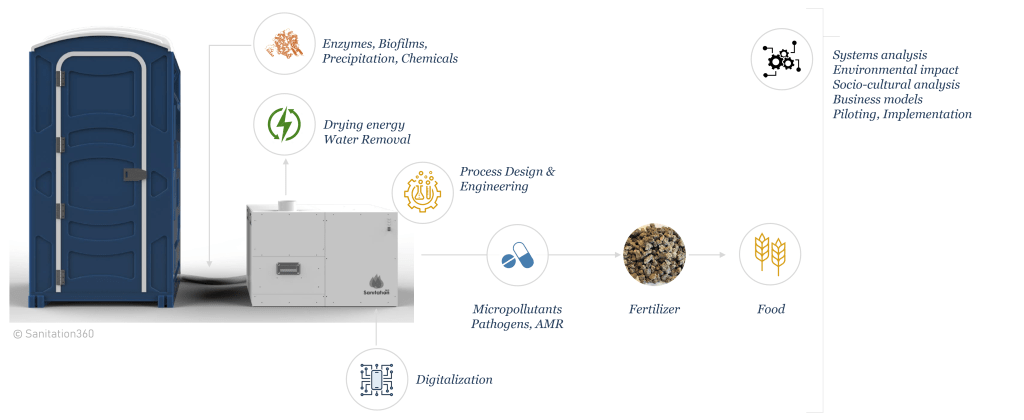
Acidification and Drying Process
Gao, Y., Vinnerås, B., & Simha, P. (2025). Partitioning behavior and crystallization of urea, salts and water during stepwise dehydration of acidified human urine by evaporation. Science of the Total Environment, 966, 17870. Link: https://doi.org/10.1016/j.scitotenv.2025.178709
- Takeaway: This paper explains the step-by-step chemistry of how urea, salts, and water separate and crystallize when acidified urine is dried through evaporation. It provides the scientific foundation for the AirCloset’s drying process, showing how nutrients are conserved in solid form as Granurin.
Simha, P., Vasiljev, A., Randall, D. G., & Vinnerås, B. (2023). Factors influencing the recovery of organic nitrogen from fresh human urine dosed with organic/inorganic acids and concentrated by evaporation in ambient conditions. Science of The Total Environment, 879, 163053. Link: https://doi.org/10.1016/j.scitotenv.2023.163053
- Takeaway: This study tested how adding different organic (citric, oxalic) and inorganic (sulphuric, phosphoric) acids to urine affects nutrient recovery during drying. It showed that acidification keeps urine stable (pH ≤ 3), prevents urea breakdown, and produces a solid fertiliser with high nitrogen content (18–21%) alongside phosphorus, potassium, and carbon. The results provide the scientific basis for the AirCloset’s acidification process, showing why adding acid is essential to preserve nutrients and reduce smells.
Perez-Mercado, L. F., Simha, P., Moreira, A. P., Paulo, P. L., & Vinnerås, B. (2024). Circular fertilisers combining dehydrated human urine and organic wastes can fulfil the macronutrient demand of 15 major crops. Science of the Total Environment, 951, 175655.
Link: https://doi.org/10.1016/j.scitotenv.2024.175655
- Takeaway: This study shows that Granurin can be blended with other organic wastes to match the nutrient needs of different crops and be adapted to specific agricultural demands of different contexts.
Demissie, N., Simha, P., Vasiljev, A., & Vinnerås, B. (2024). Photoinactivation of jack bean (Canavalia ensiformis) urease in fresh human urine using dichromatic low-pressure UV irradiation. Chemical Engineering Journal, 484, 149708. Link: https://doi.org/10.1016/j.cej.2024.149708
- Takeaway: This research shows that treating fresh human urine with specific ultraviolet light can deactivate the enzyme urease, which is responsible for breaking down urea into ammonia. By stopping that process early, this method helps reduce smell, nutrient loss, and supports the production of Granurin fertiliser in systems like AirCloset.
Vinnerås, B., Palmquist, H., Balmér, P., & Jönsson, H. (2006). The characteristics of household wastewater and biodegradable solid waste—A proposal for new Swedish design values. Urban Water Journal, 3(1), 3–11. Link: https://doi.org/10.1080/15730620500519302
- Takeaway: This paper evaluates the composition of household waste streams (urine, faeces, greywater, and organic solid waste) and proposes updated design values for nutrients, organic matter, and trace metals. The findings provide the baseline data that has since guided the development of source-separating sanitation systems, including urine-diverting toilets and technologies like the AirCloset.
Hygiene and Safety
Demissie, N.G., Nordin, A.C., Simha, P., Conroy, I., Sun, H., Schnürer, A., Vinnerås, B. and Desta, A. (2025). Simultaneous inactivation of antibiotic-resistant bacteria and degradation of antibiotic-resistant genes in alkalised human urine. Frontiers in Microbiology, 16, p.1605625. Link: https://doi.org/10.3389/fmicb.2025.1605625
- Takeaway: This study shows that alkalising human urine can not only stop the growth of antibiotic-resistant bacteria but also break down the resistance genes they carry. It provides a safety benchmark for urine-derived fertilizers by demonstrating very low AMR transfer potential after treatment.
Senecal, J., Nordin, A., Simha, P., & Vinnerås, B. (2018). Hygiene aspect of treating human urine by alkaline dehydration. Water Research, 133, 19–25. Link: https://doi.org/10.1016/j.watres.2018.07.030
- Takeaway: This hygiene study tested whether pathogens could survive in dehydrated urine mixed with alkaline materials like ash. Results showed that bacteria and viruses were quickly inactivated, while parasitic eggs (Ascaris) were reduced to safe levels with time and temperature. The findings confirm that drying urine can produce a fertiliser that meets WHO safety guidelines for unrestricted agricultural use.
Demissie, N., Simha, P., Lai, F.Y., Ahrens, L., Mussabek, D., Desta, A., & Vinnerås, B. (2023). Degradation of 75 organic micropollutants in fresh human urine and water by UV advanced oxidation process. Water Research, 242, 120221.
Link: https://doi.org/10.1016/j.watres.2023.120221
- Takeaway: This paper shows that UV-based advanced oxidation can degrade a wide range of organic micropollutants, such as pharmaceutical residues, in urine. Since the AirCloset already relies on sunlight, which provides natural UV radiation, this process can further help ensure that Granurin stays clean, even from trace chemical residues
Environmental and System Impacts
Aliahmad, A., de Morais Lima, P., Kjerstadius, H., Simha, P., Vinnerås, B., & McConville, J. (2024). Consequential life cycle assessment of urban source-separating sanitation systems complementing centralized wastewater treatment in Lund, Sweden. Water Research, 268, 122741. Link: https://doi.org/10.1016/j.watres.2024.122741
- Takeaway: This study finds that sanitation systems that separate urine (and optionally black/grey water) reduce greenhouse gas emissions, eutrophication, acidification, and ozone depletion much more than traditional centralized wastewater treatment. It shows that implementing urine recycling in an urban context (like the AirCloset) gives big climate and environmental benefits.
Perez-Mercado, L. F., Perez-Mercado, C. A., Vinnerås, B., & Simha, P. (2022). Nutrient stocks, flows and balances for the Bolivian agri-food system: Can recycling human excreta close the nutrient circularity gap? Frontiers in Environmental Science, 10, 956325. Link: https://doi.org/10.3389/fenvs.2022.956325
- Takeaway: This study maps out how nutrients (nitrogen, phosphorus, potassium) move in the Bolivian food system and estimates how much of those nutrients could be reused by recycling human excreta. It shows that urine recycling systems like the AirCloset could significantly close nutrient gaps in agriculture, making farming more sustainable and reducing dependence on imported fertilisers.
Social Acceptance and Community Perspectives
Simha, P., Barton, M. A., Perez-Mercado, L. F., McConville, J. R., Lalander, C., … (2021). Willingness among food consumers to recycle human urine as crop fertiliser: Evidence from a multinational survey. Science of The Total Environment, 765, 144438. Link: https://doi.org/10.1016/j.scitotenv.2020.144438
- Takeaway: In a survey of 3,763 people across 16 countries, 68% supported recycling urine and nearly 60% said they were willing to eat food grown with urine fertiliser. The study shows that acceptance is strongly influenced by perceptions of risks and benefits and by social norms. It concludes that consumer acceptance is unlikely to be the biggest barrier. This means that technologies like the AirCloset can succeed if awareness, trust, and good communication are built together with local communities.
Simha, P., Lalander, C., Vinnerås, B., & Ganesapillai, M. (2017). Farmer attitudes and perceptions to the re–use of fertiliser products from resource–oriented sanitation systems–The case of Vellore, South India. Science of the total environment, 581, 885-896. Link: https://doi.org/10.1016/j.scitotenv.2017.01.044
- Takeaway: This study surveyed 120 farmers in southern India to understand their attitudes toward using urine and faeces as fertilisers. Most farmers were positive about using urine (59%), motivated by soil improvement and reduced fertiliser costs. Negative views were linked to fear of ridicule, crop failure, and uncertainty about consumer acceptance. The results highlight that trust, dialogue, and involving farmers early are key to wider adoption of urine-based fertilisers like Granurin.
van der Merwe, G., & Simha, P. (2023). Approaches for bridging the sanitation delivery gap in urban informal settlements in Namibia. City and Environment Interactions, 20, 100120.
Link: https://doi.org/10.1016/j.cacint.2023.100120
- Takeaway: This study analyses how NGOs and development agencies are delivering sanitation in Namibia’s informal settlements, where shack dwelling is the norm. It compares three bottom-up models, their philosophies, and technical approaches. It also highlights how urine source separation and recycling using solutions like the AirCloset could improve sanitation in informal settlements.